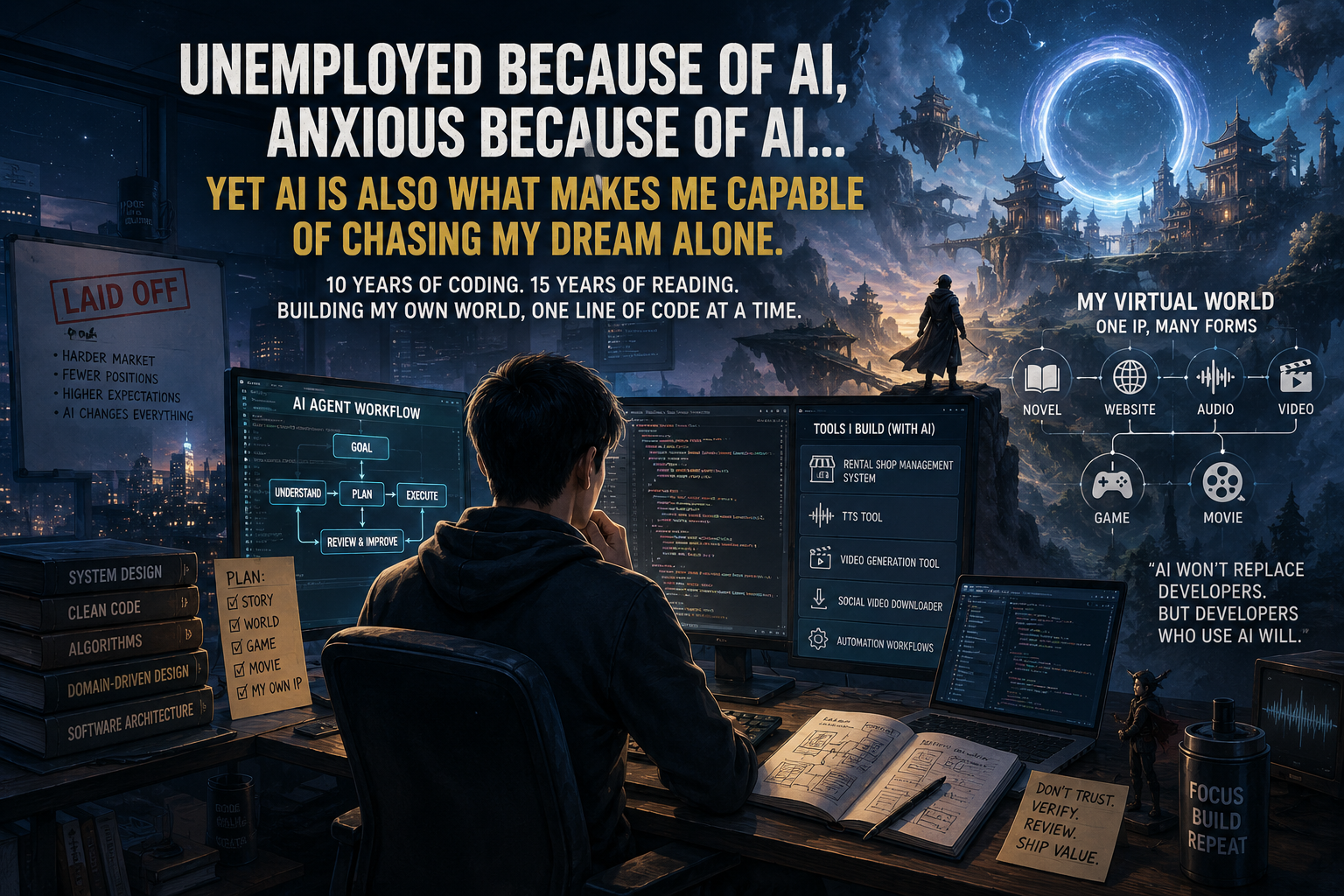

Unemployed Because of AI, Anxious Because of AI… Yet AI Is Also What Makes Me Capable of Chasing My Dream Alone
13/08/2026
25
views
2
#1 on leaderboard of challenge:

There is a strange irony in my relationship with AI.
AI has contributed to me becoming unemployed.
But unemployment gave me something I had been missing throughout years of full-time work:
Time.
And somehow, AI is also helping me turn that unexpected free time into an opportunity to pursue a dream I used to believe was far beyond what one person could realistically build.
I do not just want to write a novel.
My dream is a little bigger than that:
I want to build a virtual world of my own.
The novel is only the foundation.
If I can take it far enough, I want that world to eventually have its own website, structured data, voices, visuals, videos, games, and perhaps one day, even films.
That sounds fairly ambitious for someone who is currently unemployed.
Yet strangely enough, at the very moment when AI makes me most uncertain about my career, it is also making me feel for the first time that:
Maybe I really can start building this on my own.
After 10 years as a developer, I started wondering: how valuable is writing code itself anymore?
I have been working as a developer for around 10 years.
That makes the speed at which AI is changing software development impossible for me to ignore.
In the past, implementing a feature might start with reading requirements, navigating the codebase, understanding the existing flow, writing code, debugging, refactoring, testing, and so on.
Today, AI can participate in almost every part of that process.
Need a component?
AI can write it.
Need to refactor a function?
AI can propose several approaches.
Do not understand a piece of legacy code?
AI can explain it.
Need to figure out where a state is being modified across a large project?
Give AI enough of the codebase and ask it to trace the flow.
Regex, SQL, scripts, test cases, documentation, migrations, data processing...
The list keeps getting longer.
And what actually worries me is not that AI can write a function.
The bigger question is:
How much more work can one developer with AI accomplish compared with that same developer a few years ago?
If a team once needed ten people, will it still need all ten in the future?
I do not know.
But I do know that I am gradually becoming evidence for why that question exists.
Because the better I become at using AI, the more work I can handle by myself.
Then, while the industry was going through all these changes, I became unemployed.
I do not believe AI was the only cause. The economy, company downsizing, hiring demand, and many other factors all played a role.
But for me, AI is clearly part of the larger shift that is taking place.
And that leaves me in a rather ironic position:
The technology that makes me worry that companies may need fewer people like me is also making me need fewer people to build my own projects.
I no longer use AI just to write code
At first, I used AI in much the same way many developers do:
Task → ask AI → get code → modify it → run it.
Over time, that workflow began to change.
I stopped thinking of AI as merely a smarter autocomplete.
Instead, I started giving it entire chains of work.
Read the codebase.
Find the relevant files.
Analyze the problem.
Suggest possible solutions.
Implement one.
Review the changes.
Fix the issues.
Generate a patch.
Check what else might be affected.
I gradually moved from asking isolated questions toward a more agentic workflow: breaking larger objectives into multiple steps and letting AI work through those steps under my supervision.
For some tasks that I previously had to perform manually from beginning to end, I can now start with a different question:
What result do I actually want at the end?
Then I design a workflow that allows AI to move toward that result.
Once I started thinking this way, I began looking at almost everything around me with a developer's instinct:
“Can I automate this?”
I started digitizing almost everything I do
This is probably where AI started changing not only how I code, but how I live.
I run a rental shop.
Instead of searching for an existing management system and forcing my workflow to fit somebody else's software, I can build my own system around the way my shop actually operates.
Missing a feature?
Build it.
The workflow changes?
Modify it.
Need a new type of report?
Add it.
Want to produce audio content?
I build my own TTS tool.
Need a workflow for creating videos?
I build video-processing tools.
Want to collect social videos as research material and build my own dataset?
I write tools to help with that.
Whenever I encounter a repetitive task, my first instinct is increasingly to figure out how to automate it.
Many of these tools are things I probably would never have built in the past.
If writing one from scratch required several days or weeks of development, the problem simply would not have been important enough to justify the effort.
AI changes that equation dramatically.
An idea I have in the morning can sometimes become a working prototype by the evening.
It may not be elegant.
It may not be complete.
But it works.
And for me, that is a significant change.
In the past, software was mostly something I built for companies or clients.
Now I increasingly build software to increase my own capabilities.
From software developer to someone who builds tools for himself
This is probably the most interesting part of AI to me.
Someone without a programming background can already do a great deal with AI.
But when someone who already understands software development gains access to AI, the leverage becomes even greater.
When AI gives me a piece of code, I do not have to blindly trust it.
I can read it.
I can see where the architecture is heading.
I can recognize excessive coupling.
I can tell when a piece of logic will become difficult to maintain.
I can spot unnecessary abstraction.
I know the difference between a quick hack that happens to work and something that has a reasonable path toward future expansion.
After roughly ten years in the profession, what AI accelerates for me is no longer simply my ability to write code.
It accelerates my ability to turn an idea into software.
Those are not exactly the same thing.
And the more I use AI, the more I realize:
Programming experience does not become worthless because of AI. Its value shifts from “being able to manually write every line of code” toward “knowing what should be built, how it should be built, and whether AI is doing it correctly.”
Of course, I had to pay some tuition to learn that lesson.
And some of it was expensive.
I trusted AI too much once and ended up with a pile of garbage I could no longer debug
There was a period when I became accustomed to how quickly AI could modify code.
A bug appeared?
Give it to AI.
AI fixed it.
Another bug?
Give it back.
It fixed that too.
The application seemed to work.
Keep going.
New feature?
Add another patch.
Patch on top of patch.
And because results arrived so quickly, there were times when I skipped something no experienced developer should skip:
Code review.
Eventually, the source still worked in certain flows, but internally the architecture had turned into a mess.
Fix one thing, break another.
AI would read code that AI itself had generated and add yet another patch on top of it.
The context kept growing.
The original architectural decisions gradually disappeared.
Eventually, I reached the worst possible state:
I could no longer debug it.
The price was rewriting a large portion of the codebase from scratch.
Painful.
But useful.
It taught me a rule I now try very hard to follow:
AI can write code extremely quickly. But I am still responsible for the codebase.
Skipping review because “AI probably got it right” is basically the same as merging code from a developer you have never met without reading the diff.
Except this particular developer can generate thousands of lines of code while you are making coffee.
Then sometimes I go too far in the opposite direction
After that experience, I became much more careful about reviewing AI-generated code.
Sometimes perhaps... too careful.
This is where ten years of programming habits become a slightly ridiculous problem.
I look at a piece of AI-generated code and think:
“It works, but it is ugly.”
So I ask AI to rewrite it.
“This function is too long.”
Rewrite it.
“Separate the responsibilities.”
Rewrite it.
“This naming does not follow the convention.”
Rewrite it.
“This architecture will be difficult to extend later.”
Rewrite it.
“Refactor it and make it clean.”
Rewrite it again.
Eventually, I may have spent several hours polishing a personal tool that I will use only a few times a month.
No additional revenue.
No user cares.
No additional problem has been solved.
But the code looks beautiful.
Beautiful in a way that is... economically meaningless.
This may be one of my hardest old habits to break.
Years of software development taught me that code should be clean, maintainable, standardized, and extensible.
That is not wrong.
But AI increases the speed of software creation so dramatically that another question becomes much more important:
“Is this piece of code actually worth another two hours of polishing?”
I still do not always answer that question correctly.
Sometimes I am working on a tool that only I use, glance at the clock after midnight, and realize:
I just refactored something that will probably never need to scale.
AI saved me three hours of writing code.
Then I spent exactly those three hours asking AI to make the code prettier.
Net time saved: zero.
Very developer of me.
AI does not give me more free time. It gives me the ability to do more
And that is probably my answer to the question “Easier or Busier with AI?”
For each individual task:
Much easier.
For my life as a whole:
Busier.
Something that used to take four hours may now take one.
But those other three hours do not magically become leisure time.
Instead, I think:
“Then I can build this too.”
Already have a TTS tool?
Build the next stage of the audio pipeline.
Already have a website?
Improve the data system.
Already have the data?
Automate more of the workflow.
Automation works?
Start thinking about which parts can be delegated to agents.
AI does not make my to-do list shorter.
It removes the limits on what I am willing to put on that list.
And that is also how an old dream started becoming much more serious.
15 years of reading fiction, 10 years of programming, and a dream that may be a little too ambitious
I have been reading fiction for around 15 years.
Long enough to accumulate a great deal of knowledge that I never really thought of as “experience.”
I have read enough stories to feel when a character's actions are unnatural.
When a plotline is being forced.
When a new power appears only because the protagonist needs to be saved.
When a fictional world exists merely as background decoration rather than as a place governed by its own rules.
I know what kind of worlds I enjoy.
What types of plot devices I dislike.
How I want characters to grow.
And I want to build a world of my own.
Thiên Đạo Chi Lộ started from that desire.
But my ultimate goal is not simply to finish a novel.
I want to build a world/IP that can exist across different forms of media.
The novel is the foundation because it is the most accessible way to establish the lore, characters, history, geography, power systems, and conflicts of that world.
But from that foundation, I want to keep experimenting.
Audio.
Images.
Video.
Interactive websites.
Games.
And, if I ever reach that point, films.
Perhaps I will never make it to the final stage.
But the important difference is that, for the first time, I can look at that entire chain and no longer immediately think:
“You would need an entire company to do this.”
Instead, I ask:
“Which part can I build myself first?”
AI does not replace my 15 years of reading or my 10 years of programming
This is something I find particularly interesting.
People often ask whether AI will make experience meaningless.
My experience has been almost the opposite.
The stronger AI becomes, the more valuable my accumulated experience feels.
With code, I have around ten years of experience helping me recognize when AI is producing a reasonable solution and when it is building a technical time bomb.
With fiction, I have spent around fifteen years reading enough stories to look at an idea AI proposes and say:
“No.”
“Too cliché.”
“That character would never do that.”
“This is too convenient.”
“The world does not work that way.”
“This idea is good, but it needs to be foreshadowed a hundred chapters earlier.”
I do not need AI to make decisions for me.
I need it to generate possibilities faster than I could generate them myself.
Then I review.
Challenge.
Reject.
Combine.
Redirect.
And ask it to continue.
Seen this way, my role is changing significantly.
In the past, I personally produced most of the output.
Now, for many kinds of work, I increasingly behave like the person who designs the system, defines the standards, and reviews the output.
Almost like a Tech Lead.
Except sometimes my entire team is made of AI.
The good news is that this team never asks for a raise.
The bad news is that if I give it insufficient context, it can enthusiastically destroy production.
From chatbot to AI agents
I think this is also the most important evolution in how I use AI.
If I use AI only like this:
“Write this function.”
“Rewrite this paragraph.”
“Create this prompt.”
then AI is extremely useful, but it is still mostly a tool that responds to individual instructions.
What interests me now is something different:
AI executing an entire workflow.
For example, an agent could receive an objective, inspect the current data, determine which steps are required, call the appropriate tools, generate an output, validate the result, and then hand it over to the next stage.
Another agent could handle content.
Another could review logic.
Another could process data.
Another could work on code.
Automation can connect all of those stages.
Of course, I still need to supervise a lot of it.
And after letting AI turn one codebase into an undebuggable mess, I no longer believe in the fantasy of “press one button and AI will do everything.”
But the direction itself fascinates me.
Because when AI can use the tools I build, while I can also use AI to build new tools for AI...
a rather interesting feedback loop appears:
I use AI to build tools.
Those tools allow AI to do more.
A more capable AI workflow then helps me build the next generation of tools faster.
For an individual, that is a level of leverage that I could barely imagine having only a few years ago.
Maybe what I am building is not actually a novel
The further I go, the more I realize that Thiên Đạo Chi Lộ is only the most visible part.
What I really want to build behind it is a system.
A place where lore is stored in structured form.
Characters have timelines.
Factions have relationships.
Events have causes and consequences.
A website can consume that data.
A TTS tool can transform the content into audio.
Video tools can use character and world data to assist with content production.
One day, perhaps a game could use the same data.
And if the world expands further, other forms of media could still be built on top of the same foundation.
At that point, my programming background and my love of fiction stop being two separate interests.
They finally meet.
Fifteen years of reading stories gives me the intuition for the world I want to create.
Ten years of programming gives me the ability to turn that world into systems.
AI gives me the leverage to attempt it at a scale I would never previously have considered possible for one person.
That is the real dream.
And I am still anxious about AI
I do not believe the statement:
“AI is just a tool. There is nothing to worry about.”
I think there is plenty to worry about.
Repetitive jobs will be affected.
Teams may become smaller.
One person with AI can handle workloads that previously required several people.
Productivity expectations will continue rising.
And software development may gradually have to move away from measuring a developer's value by how much code they can personally write.
That is frightening.
Especially when I am the one looking for a job during this transition.
But there is another truth I cannot ignore:
If AI allows a company to accomplish more with fewer people, it also allows an individual to attempt things that previously only a company had enough resources to build.
Those are not two different phenomena.
They are two sides of the same one.
The difference is simply which side of the table I am sitting on.
As an employee, it scares me.
As someone trying to create something of my own, it looks like an enormous door opening.
The thing that helped take away my job may also help me build one for myself
I am still looking for work.
I am still a developer.
And if the right opportunity appears tomorrow, I will probably continue working professionally just as I did before.
But something has changed.
In the past, I believed that pursuing this dream would require:
More money.
More time.
A writer.
A designer.
A video editor.
A development team.
Marketing.
Perhaps even an entire studio.
I no longer wait until I have all of those things.
I am starting with what I already have:
15 years of reading fiction.
10 years of software development.
A computer.
The unexpected time that unemployment gave me.
And AI.
AI contributed to me losing my job.
Unemployment gave me time to begin.
Experience gives me the ability to review and guide AI.
And AI gives someone like me the ability to code, build tools, automate workflows, create content, and gradually construct a world that I once believed would require an entire team.
So has AI made my life easier or busier?
Both.
It makes each individual task easier.
But it also makes the things I am willing to dream about much bigger.
And when the dream gets bigger, the amount of work never really gets smaller.
It is rather ironic that the technology that once made me ask:
“Will companies still need a developer like me a few years from now?”
is now making me ask a completely different question:
“With AI, how much can a developer like me build on his own?”
I do not know the answer yet.
But at least now, I have the time to find out.