
Đọc bản tiếng Việt ở đây.
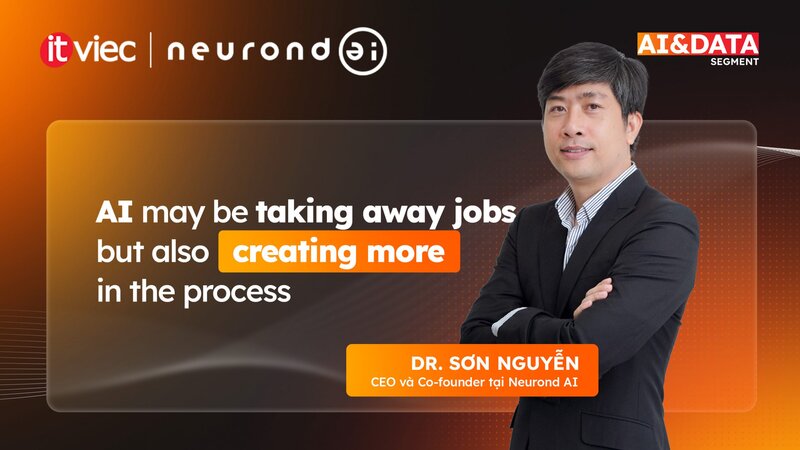
The technological landscape is undergoing a fundamental revolution driven by Artificial Intelligence (AI), moving far beyond hype to create tangible shifts in the job market and career expectations. To unfold this topic, ITviec is honored to welcome Dr. Son Nguyen, CEO and Co-founder of Neurond AI and a top AI expert. The interview with Dr. Son explores not only the disruptive realities, but also emergent opportunities defining the modern tech career landscape.
According to Dr. Son Nguyen, the current shift is not just about adopting new tools; it is about redefining individual value, embracing new skills, and developing an AI-first mindset. For individuals, the key to survival and growth lies in understanding the core nature of this revolution and anchoring their expertise in areas where AI cannot yet compete.
Let’s dive in!
For Junior-level and Middle-level: What’s really happening in the IT hiring market in Vietnam?
The Junior vs. Agent dilemma
This dramatic shift is driven by economic necessity for business owners. Before the AI revolution, there was an implicit agreement between employer and employee: the employer would take in Junior talent, and in turn, the Junior would have the opportunity to learn, even if they did not bring much value initially. Now, the AI revolution has introduced a new competitor that will break this unwritten agreement: an AI agent working just like a Junior.
Dr. Son emphasizes a sad truth:
What if a business owner is faced with having an agent that works like a Junior?
They do not have another option but to choose the most competitive solution, otherwise, their competitors will gain an edge.
The short answer regarding the current IT hiring market in Vietnam is that there is a visible downtrend. This trend is not confined to Vietnam but reflects an international phenomenon. Specifically, there is a downtrend in hiring Junior-level engineers, which is slowly eating into the low level of Middle-level engineers and Dr. Son predicted this hiring downtrend will keep increasing to the full layer of Middle-level engineers in Vietnam in the near future.
To back up these statements, a recent ITviec survey showed a 7% drop in Junior and Middle hiring demand in the second half of 2025 compared to the first half of the year. Crucially, 24.7% of companies cited the productivity gains from AI implementations as the reason for freezing hiring or downsizing.
The solution for Junior developers, therefore, is not to deny the change but to prepare well and understand the potential for growth.
The unique strengths of young talents
Despite the job downturn, Junior and young talent possess inherent strengths that can be leveraged for success. Dr. Son highlights three key advantages for the younger generation:
- Beginner’s Eyes of Curiosity: Older generations often stop asking why they need to perform certain tasks, simply accepting existing workflows. Juniors, by contrast, come in and ask why, which is a very valuable thing that can help reshape the working flow or even the business, creating significant value.
- Early adopter of technology: Young people are early adopters of technology, easily immersing themselves in new tools like AI.
- Fast feedback loops: As they engage heavily in community discussions, they can get the feedback directly and very fast from the community. This rapid feedback loop is vital because nowadays everything we do, we need to do it very fast.
Three essential pieces of advice for Junior Tech professionals
To successfully navigate this period of transition, Dr. Son provides three critical pieces of advice for young talent:
- Embrace the revolution:
Do not go against the revolution. Instead, work alongside the GenAI tools, large language models, and code generation tools that are constantly improving in quality. The key is to talk to the machine every day.
- Ship small but share loud:
Vietnamese developers, in particular, often struggle with shyness when talking about their achievements. It is essential to overcome this and show achievements to the public.
This not only serves as personal marketing but, more importantly, provides immediate feedback, which can lead to rapid iteration and even the creation of a very useful product. The focus should be on finishing a small project from beginning to the end to understand the full cycle.
- Anchor yourself with deep expertise:
It is critical to become good at one or at least one or two or three if you can but with in-depth level. With so many things available to learn, individuals must anchor themselves with one specific area or domain in which they are passionate or have dominant strength. This helps prevent jumping around and failing to become an expert in any single area, making the individual much more valuable.
This anchoring domain does not necessarily need to be technical. Dr. Son believes the business side could be the gold mine for everyone should look into. The goal is to start with something the individual is good at; if that aligns with passion, that is the best-case scenario, but even if not, passion can develop over time from successfully executing tasks.
For IT professional of all level: The core survival skill in this AI revolution
The top three roles predicted to vanish
Not just warning that Junior and low Middle-level engineers are at risk, Dr. Son also predicts that these three IT roles will gradually vanish in the next 18 to 24 months, or even sooner:
- Manual QA tester: AI agents can perform this work with very high quality and very low cost.
- Low-level IT help desk: General questions can be answered precisely and patiently by AI agents at any time.
- Boilerplate Front-end engineer: New tools for front-end development, like Vero, are reducing the burden of front-end work by approximately 90%.
The two paths to success
In this new era, Dr. Son observes two distinct types of individuals who are positioned to become the winners of the AI revolution:
The first path: The Nerd (Deep technical expertise)
This is a really technical person who goes very deep into one technical area. This individual possesses unique, specialized knowledge that is incredibly valuable.
For the majority of Senior developers who are not hyper-specialized researchers, success still lies in deep, narrow expertise:
- Digging deeper: Successful Senior engineers must go much deeper, dig much deeper into the knowledge to become very strong at a very narrow area but also very valuable.
- Unique knowledge: This success comes from knowledge that is not publicly available or widely known. Since large language models (LLMs) are trained on public data, the value of an engineer is tied to understanding company-specific knowledge or a very rare set of data that the LLM cannot access. Companies will not easily give out their IP or private data to LLM creators. Pursuing this kind of hidden knowledge is becoming much more important.
The second path: The Domain Expert (Applied AI Talent)
The second successful type is the domain expert – the professional who applies AI capabilities to solve practical, domain-specific problems. Dr. Son emphasized that with the ease of modern AI tools, domain experts can easily create a prototype or an MVP (Minimum Viable Product) to showcase their idea, which makes it easier for them to secure funding and build a technical team.
This domain expert role transitions directly into the concept of Applied AI Talent – professionals who combine their specific domain knowledge (psychology, medicine, finance) with the current capability of AI to solve domain-specific problems. Before, solving such problems required expertise in software engineering, data engineering, and AI skills; now, it is simplified enough that individuals can combine their existing knowledge and finish at least the MVP.
Fundamental soft skills for all IT professionals
While AI generates code, a good developer will be able to ask a better question and know what direction to guide the model to provide the correct answer. More critically, the Senior developer needs to validate the output better.
For sophisticated systems with large user bases and high demands for performance and availability, Dr. Son notes that LLMs have not yet reached the level required to fulfill those demands; he predicts this reliance on human expertise will persist for at least the next two years.
Beyond coding, success in the AI era requires leveraging fundamental soft skills:
- Orchestration
- Self-learning
- Proactivity and Agile mindset
- Teamwork and Coordination
- Security and Data Privacy: This is increasingly important, as a company can get bankrupt if they’re not careful enough with those things.
The core survival skill in this AI revolution
Dr. Son stressed that if there is one key message that individuals should focus on during this revolution, it is:
Sharpening our skill of asking questions.
Dr. Son draws a critical parallel between the Internet revolution and the AI revolution:
- The Internet brought the revolution of information. Companies like Google and Meta became global leaders by indexing and sharing that information, putting it at the fingertips of every person.
- The AI revolution brings answers. Basically, every answer in the world is now available at your fingertip, provided you can ask the right question in the right way.
Since AI is supplying the answers, human value shifts to defining the problem and guiding the solution. Asking the right questions – such as “Can we do something to solve it?” or “Is there any way that we can improve this?” – is what drives new ideas and innovation.
For Organizational survival: What’s to do and what’s not to do?
The AI-first employee mindset
The burden of adaptation does not fall solely on individuals; companies must evolve their culture and workflows. Neurond AI, for instance, has fundamentally changed the way they recruit and expect people to work.
The critical shift is to help employees adopt an AI-first mindset. This means every team member must think and try to leverage the power of AI before doing it by yourself. If employees fail to adopt this mindset, the company’s productivity will not be competitive compared to rivals.
This change requires significant investment in training, especially mindset training, which Dr. Son considers the most important training undertaken. The expectation is not that back office, sales, or marketing teams become AI experts, but that they begin asking the question, “Can I do this? Can I do that?” to improve processes, rather than just finishing the job the way it has been done for years.
While this is the intention of the business, the employees may not feel the same. The only way to address internal resistance to these rapid changes is to be open and transparent, emphasizing that the goal is not replacement but becoming more competitive and efficient, which ultimately leads to better jobs and benefit packages for employees.
The bitter lesson: Never underestimate the speed of AI
Dr. Son shared the story of an AI project aimed at document intelligence for a fintech client. The team used classical machine learning methods and committed to achieving 90% accuracy, eventually hitting 92% accuracy – exceeding the expectation. However, during the preparation for deployment, the team tested a cutting-edge LLM solution which immediately achieved 95% accuracy. The team was forced to scrape all of the work that we have done and use the LLM solution.
It was not that the project failed technically, but that the team failed to have a good prediction of another methodology.
The lesson was that every technology project must now consider the pace of progress of new tools and technologies.
Future IT roles: Where to invest your skills?
The transition is creating demand for roles that were unheard of just five years ago. Individuals looking for long-term growth should focus on these emerging areas:
IT roles experiencing growing demand
- Data Architect: This role is becoming crucial because the origin of AI is data. Without good data (garbage in, garbage out), AI cannot function. The Data Architect’s job involves preparing, transforming, and manipulating high-quality data to leverage AI’s strength.
- Software Architect: As AI generates more functions and modules, the Software Architect is needed to coordinate these components, putting things together to ensure the system runs in an efficient way and make sure that every module works well together.
- Applied AI Talent/Engineer: These professionals leverage both domain knowledge and AI capabilities to solve problems, a trend that will only increase.
- Compliance: This is a crucial area of future growth. As data remains the heart of every single business and is their IP, roles related to preparing data, managing privacy, and complying with new national and international regulations (such as Vietnam’s new laws on data privacy) will be highly sought after, similar to the recent surge in demand for security experts.
Core AI expert roles (highly specialized)
These roles require a deeper understanding of AI fundamentals and are currently concentrated in regions like the US and China:
- Large Language Model Fine-tuning Specialists: This role is necessary because as LLMs scale, the vast amount of information they ingest creates noise. Fine-tuning specialists understand the fundamental structure of the neural networks and can navigate the data to ensure the model converges on the desired target (like being useful and providing factual information).
- Synthetic Data Engineers: Since LLM developers have already scrapped all information in the world, the only answer for continued model improvement is synthetic data. These engineers are responsible for preparing this new data.
New roles predicted to emerge
- Agent Architect: With the emergence of multiple AI agents working in parallel, there will be a natural need for individuals to create that agent to coordinate those agents to work well together to fix the problem when something goes wrong.
- Domain Skill Transposer: This role converts complex domain problems into encapsulated AI capabilities.
Final thoughts
In conclusion, the AI revolution is the real thing, not a temporary bubble. The path forward for individuals is defined by deep specialization (The Nerd), leveraging domain knowledge with AI (The Domain Expert), cultivating an AI-first mindset, and, above all, sharpening the skill of asking the right questions. By mastering this fundamental ability, IT professionals can shift their focus from being providers of answers to architects of solutions, driving growth in the new era of intelligent systems.
————————
| This insightful interview marks the collaboration between ITviec and Neurond AI to bring forward authentic conversations with leading tech leaders in AI and Data. Together, we aim to help Vietnam’s IT professionals gain practical perspectives on AI, Data, real stories and challenges in emerging technologies — bridging the gap between industry vision and career growth. For more insight from other leaders and latest job opportunities in AI/Data field, visit ITviec’s AI/Data Segment now! |
