
Đọc bài viết tiếng Việt tại đây.
Every organization wants to become data-driven. Businesses continue to invest heavily in cloud platforms, AI, and analytics, yet many still face the same challenge: having more data doesn’t necessarily lead to better decisions. Too often, organizations mistake dashboards, reports, and modern technology for data maturity, when the real challenge is ensuring people trust the data, understand it, and use it to make decisions.
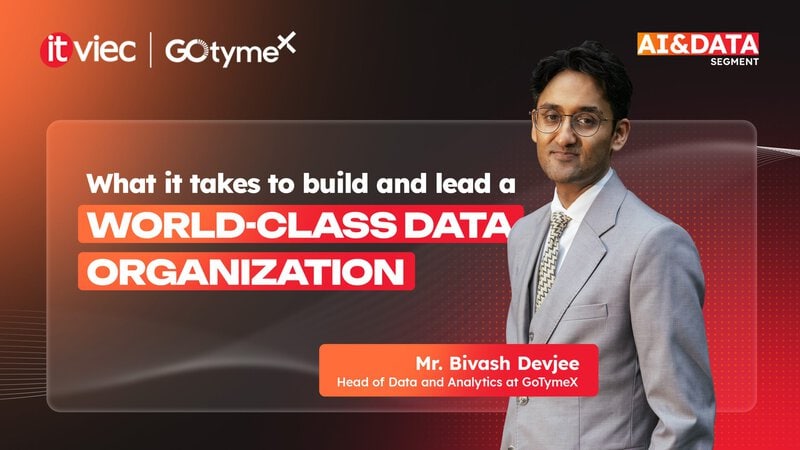
In this podcast conversation with ITviec, Mr. Bivash Devjee, Head of Data and Analytics at GoTymeX, offers a different perspective. Rather than treating data as a technical capability owned by engineers or analysts, he argues that becoming data-driven is fundamentally an organizational challenge. The differentiator is not the sophistication of the technology stack, but whether trusted data becomes part of everyday decision-making across the business.
Being data-driven is about decision-making
For many organizations, becoming data-driven is synonymous with investing in technology. Modern data platforms, business intelligence tools, and AI-powered analytics promise greater visibility into every aspect of the business. Yet access to more information does not automatically lead to better decisions.
When asked what it means to be a data-driven organization, Mr. Bivash offers a definition that shifts the focus away from technology altogether:
“Being data-driven is not about dashboards. It’s about using data to make a decision at every step of the organization.”
This distinction reframes the role of data within an organization. Dashboards, reports, and analytics are not the end goal, they are tools that support decision-making. A company becomes data-driven not when it has access to more data, but when employees across different functions consistently use trusted information to validate assumptions, prioritize actions, and solve business problems.
That also means becoming data-driven is not solely the responsibility of a data team. While data professionals build the capabilities that make information accessible, the real measure of success is whether data becomes part of how the entire organization thinks and operates. When decisions at every level are grounded in evidence rather than intuition alone, data evolves from a technical asset into a business capability.
Reliable, Trustworthy, and Usable Data
One of the recurring themes throughout the conversation is that being data-driven depends on more than collecting and analyzing information. Data must first be reliable, trustworthy, and usable before it can support business decisions. Without that foundation, even the most sophisticated analytics capabilities risk creating confusion instead of clarity.
Mr. Bivash approaches this challenge by viewing governance as a compliance exercise, he describes it as the mechanism that ensures everyone across the organization works from the same trusted source of truth. Achieving that requires more than technology. Data quality starts at the point where data is created, issues need to be identified early in the pipeline, and responsibility for maintaining quality must extend beyond the data team to the entire organization.
This philosophy fundamentally changes the purpose of governance. Rather than acting as a control mechanism that slows innovation, governance becomes the foundation that enables faster decision-making.
As Mr. Bivash explains: “It is about the shared ownership of data quality. Everyone is behaving responsibly, everyone has an understanding of what this data means.”
When data is consistently reliable, trustworthy, and usable, teams spend less time validating numbers or resolving conflicting metrics. Instead, they can focus on interpreting insights and making better decisions. In that sense, governance is what enables an organization to use data confidently at scale.
Data capabilities are most valuable when they’re embedded in the business
A data-driven organization requires more than a strong data platform. It also depends on how data teams interact with the rest of the business.
At GoTymeX, data priorities are closely aligned with business priorities. Rather than treating every request equally, the team evaluates initiatives based on customer impact and organizational objectives. This ensures that data efforts contribute to meaningful business outcomes instead of becoming a queue of disconnected reporting requests.
The same philosophy shapes the team’s organizational structure. Alongside centralized platform teams, GoTymeX embeds analytics engineers and data scientists within product teams and regional business units. Working alongside the business gives data professionals a deeper understanding of customer behavior, market context, and product goals, context that is difficult to gain from a purely centralized function.
Technical expertise alone, however, is not enough. Bivash emphasizes that data professionals must also be able to communicate their findings in a way that business leaders can understand and act upon. Data storytelling is therefore not about presenting charts more effectively; it is about translating technical insights into decisions that move the business forward.
AI changes the role of data professionals, not their importance
As AI becomes increasingly capable of generating code, dashboards, and analytical outputs, it’s tempting to assume that the value of data professionals will diminish. Devjee sees the opposite happening.
At GoTymeX, AI is already accelerating routine tasks that once consumed significant time, allowing teams to deliver insights faster than before. But speed alone doesn’t create business value. The real challenge is ensuring that AI-generated outputs are accurate, relevant, and meaningful within the context of the business.
As Bivash explains: “AI can take care of the majority of the pieces that took a lot of time, and it’s now about understanding what the output is that we’re getting out of this and whether it makes sense to deliver to the rest of the business.”
This represents a fundamental shift in the role of data professionals. As AI takes over repetitive execution, human expertise becomes less about producing information and more about interpreting it. Critical thinking, business judgment, and the ability to challenge assumptions become increasingly valuable in a world where generating analysis is no longer the hardest part.
Building a data-driven organization ultimately means building the right culture
Technology can make data accessible. Governance can make it reliable. AI can make analysis faster. But none of these capabilities automatically lead to better decisions.
Throughout the conversation, Bivash repeatedly returns to the people behind the technology. He believes organizations should hire individuals who are curious, eager to learn, and motivated to solve problems with modern data tools. Just as importantly, they need an environment where they feel comfortable asking questions, challenging ideas, and taking ownership of their work.
That is why GoTymeX places strong emphasis on end-to-end ownership, and a sense of purpose. Team members are encouraged to contribute ideas without fear of asking the “wrong” question, and to take responsibility for delivering outcomes rather than simply completing assigned tasks. By giving people ownership and connecting their work to a broader mission, the organization creates the conditions for continuous learning and better decision-making.
In the end, becoming data-driven is not simply about building better technology. It is about building an organization where people have the confidence, context, and curiosity to turn trusted data into better decisions every day.
Conclusion
The conversation with GoTymeX offers an important reminder for organizations navigating digital transformation. Becoming data-driven is not the result of adopting a particular technology platform or building increasingly sophisticated analytics capabilities. Those investments matter, but they are only enablers.
The organizations that consistently make better decisions are those that build trust in their data, distribute ownership beyond the analytics function, integrate data expertise into business operations, and develop leaders capable of translating insight into action.
In the end, a data-driven organization is not defined by the amount of data it collects or the number of dashboards it creates. It is defined by how consistently its people use trusted information to make better decisions. When data becomes part of the organization’s culture, not just its technology stack, it evolves from a technical asset into a lasting strategic advantage.
