
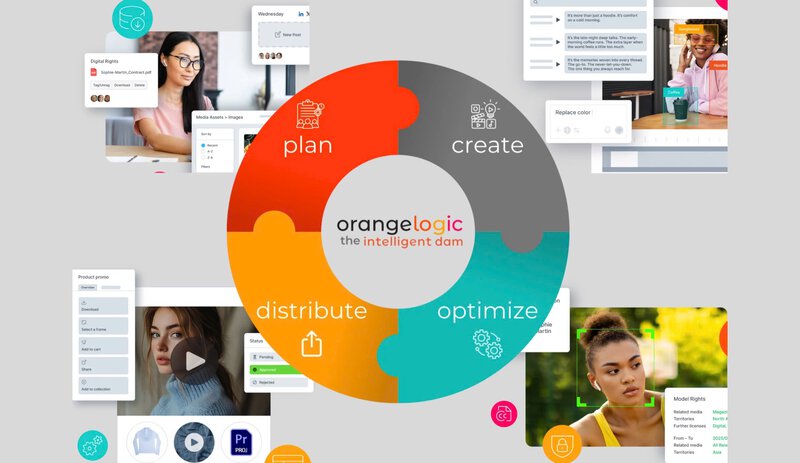
Most enterprises have millions of images, videos, and documents they can’t find when they need them. The assets exist, but the information inside them, such as who’s in the photo, what’s said in the recording, or what the document is about, is locked up in files scattered across systems with inconsistent or missing metadata. Searching is slow. Reusing existing work is harder than creating it again from scratch.
The instinct is to treat this as a content management problem with better folders, stricter tagging rules, and more disciplined librarians. That approach scales until it doesn’t. Manual tagging can’t keep up with volume. Predefined taxonomies go stale as the business changes. Eventually, organizations are paying to store data they can’t actually use.
AI changes what’s possible here. Instead of waiting for humans to describe every asset, modern systems read the assets directly: a face in a photo, a sentence in a recording, a chart in a PDF. The content describes itself, and the archive becomes searchable on its own terms.
Beyond Magic: The Philosophy of AI
Applying AI in enterprise environments goes far beyond improving user experience. It involves designing systems that can operate reliably across millions of assets, integrate with complex infrastructures, and support evolving business needs.
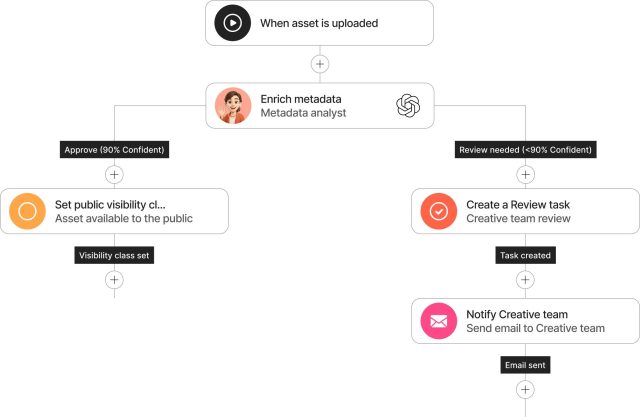
AI is increasingly used to automate processes such as tagging, classification, workflow routing, and compliance checks. A growing direction is the development of agent-based systems capable of executing multi-step tasks and adapting to specific domains. In this model, AI becomes an active participant in workflows rather than just a supporting tool.
One of the most visible shifts is in search. Traditional systems depend on exact matches such as filenames or tags, while AI-driven approaches aim to interpret user intent. This enables natural language search, more relevant results despite incomplete metadata, and faster access to information. Behind this experience lies a combination of semantic understanding, pattern recognition, and continuous refinement based on real usage.
For engineers, however, what appears seamless to users involves significant complexity underneath. Building production-ready AI systems requires continuous experimentation, evaluating trade-offs between accuracy and performance, and ensuring scalability over time. The experience may feel intuitive, but it is grounded in disciplined engineering. A useful analogy can be drawn from Alita: Battle Angel, where advanced technology appears almost magical, yet is ultimately the result of thoughtful design and engineering rigor.
Equally important is the data infrastructure that supports these capabilities. AI systems depend on scalable storage, high-performance APIs, robust data pipelines, and governance layers to ensure compliance and security. In this context, content platforms evolve into foundational data infrastructure, connecting systems, standardizing access, and enabling organizations to fully leverage their information.
As digital content continues to grow, the distinction between content and data will continue to blur. The future lies in intelligent systems that can understand, connect, and activate information at scale, reshaping how organizations interact with their own data.

Embedding AI into the Core of Content Systems
Platforms like those developed by Orange Logic, founded by Karl Facredyn, reflect this transition. What began as a solution for managing large photo archives has evolved into systems designed to treat content as a dynamic data layer: one that can be queried, enriched, and acted upon intelligently. AI is no longer positioned as an add-on feature, but as a foundational component of how these systems operate. What truly differentiates an AI team, however, is not just the technology it adopts, but how engineers are empowered to transform ideas into real, production-ready, and impactful solutions.
At Orange Logic, this means working on high-impact AI applications that solve real-world problems:
- AI Search: We enable users to search using their own words and find assets even when they don’t know the exact tags, filenames, or where an asset lives. This saves time and removes friction from discovery.
- AI Assistant: Transforms simple conversation into action, users effortlessly manage and create assets without needing to learn complex workflows
- Agentic AI Studio: Design and deploy your own AI agents with specific personalities and domain knowledge, enable autonomously handling of repetitive tasks at scale.
By handling the heavy lifting behind the scenes, AI frees users to focus on creative, strategic, and high-impact work, ultimately making their day-to-day experience simpler, faster, and more rewarding.
From Theory to Impact: The AI Transformation at AFI
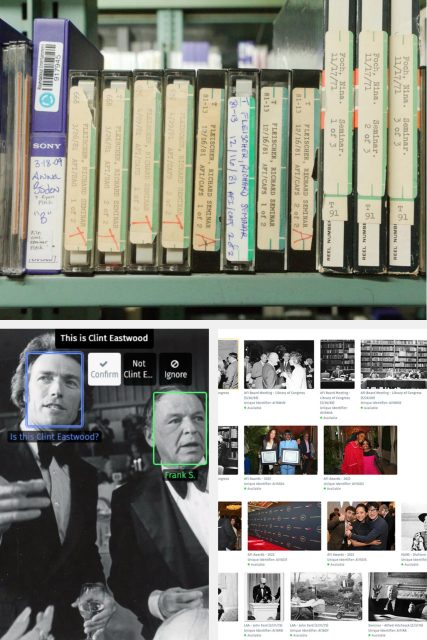
To illustrate this shift, consider the American Film Institute (AFI), a nonprofit preserving 50 years of cinematic history. Before implementing Orange Logic, their archive of over 1 million still images and 70,000 audio/video recordings was siloed across disorganized servers and physical tapes.
By embedding AI into the core of their archive, AFI achieved three critical technical breakthroughs:
- Automated Metadata Enrichment: AFI utilized Facial Recognition to process over a million assets. A batch confirm tool allowed them to go through groups of photos and confirm identifications without reviewing photos one by one.
- Easy-to-use Search: For their 700,000 recordings, AFI used AI-driven auto-captioning. This transformed audio into searchable data, allowing users to find not only a specific speaker but also every instance where that person was a topic of discussion across other assets.
- High-Velocity Asset Orchestration: With video files as large as 400 GB, users can now use AI to identify specific time codes and download only the necessary subclips directly from the DAM.
Link for reference: https://www.orangelogic.com/case-studies/american-film-institute
Orange Logic
Orange Logic is more than a software provider; we are the architects of digital ecosystems. We empower organizations to take control of their creative and functional assets through a platform that is as dynamic as their ideas. Our clients include the American Film Institute, the World Bank, and the United Nations. The work spans healthcare archives, humanitarian image libraries, brand archives, and retail content operations with different industries, same underlying problem: too many assets, not enough structure.
What truly defines us is not just our platform, but the people behind the code. We believe that extraordinary engineering begins with human passion, which is why we invest deeply in our teams. We foster a hiring process designed to attract the top-tier engineering minds who are passionate about solving impossible problems at scale. This commitment secures the expertise and creativity needed to elevate our product and ensure our clients maximize their full potential.
Also, strong ownership is a core principle for all engineers, especially the AI team in Vietnam. Engineers are not just contributors to isolated tasks; they own their features end-to-end. From early exploration and prototyping to production deployment and long-term maintenance, teams are trusted to make technical decisions, experiment with new approaches, and take responsibility for outcomes. This ownership culture creates a safe space for innovation, where learning and experimentation are encouraged rather than constrained.

Orange Logic is committed to pushing the boundaries of what is possible in the DAM and MAM spaces. As we continue to expand our footprint, we are looking for engineers, visionaries, and problem solvers who want to work on a product that impacts the world’s most recognizable brands.
Content and images belong to Orange Logic Vietnam.
