
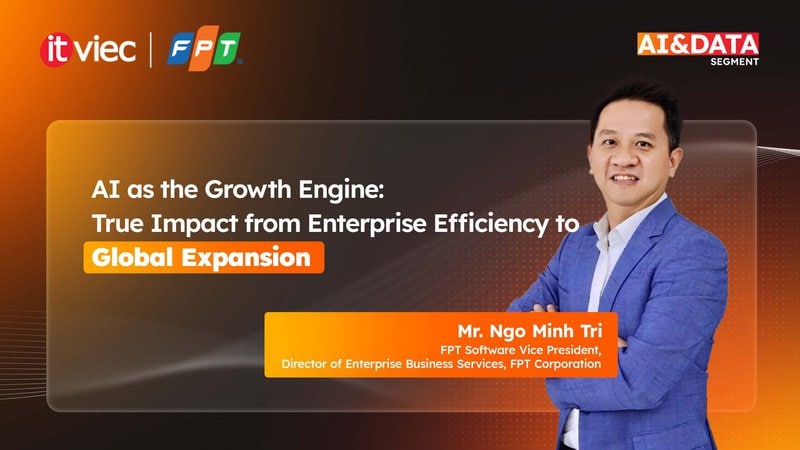
The global AI challenge is becoming increasingly complex: how can AI deliver real growth value, rather than stopping at experimentation? According to Mr. Ngo Minh Tri – FPT Software, Vice President, Director of Enterprise Business Services, FPT Corporation, AI only becomes a true growth engine when it can drive productivity and business outcomes across the entire organization. However, achieving this at an enterprise scale is a significant operational challenge.
Drawing from his extensive experience with international clients, Mr. Tri shared a key insight with ITviec: the “curiosity phase” of AI is over. Clients are moving from asking “Can we do AI?” to demanding higher-level outcomes:
- How fast can AI be deployed?
- How can financial impact be measured?
- Can AI be deeply embedded into core systems such as SAP financial processes or supply chain operations?
This shift is inevitable now as AI has become highly accessible. As a result, the AI advantage has been redefined: it’s no longer about simply “having AI,” but about the capability to deploy AI effectively to create growth.
To meet these new demands, EBS and FPT Software have defined three objectives to strengthen internal AI capabilities. AI must help:
- Increase productivity with the same level of resources
- Accelerate operational speed
- Enable data-driven decision-making instead of instinct
How has EBS approached this strategy in practice? Let’s explore insights shared directly by Mr. Ngo Minh Tri:
Setting the right goals: Micro goals, macro impact
When EBS first began exploring AI in 2023, the team avoided overly ambitious goals. Instead, they focused on creating short-term, practical value that could be clearly measured in day-to-day work.
In 2024, the EBS AI Program was officially launched with a very specific question: How can each engineer improve productivity by 20–30%? Based on this objective, AI initiatives were implemented in short cycles of two to four weeks, allowing employees to quickly see tangible improvements in their daily tasks.
Mr. Tri explained: “Our approach is very simple. Every AI tool must save time or measurably reduce effort. When an engineer saves 30 minutes a day, or a manager can access real-time data instantly, they naturally want to use AI. That is how AI adoption gains momentum across the organization.”
Training AI like a junior employee: Patiently mentor it with domain expertise
Like many enterprises, EBS leverages existing models rather than building from scratch. The challenge, however, is that general-purpose AI models such as ChatGPT perform well on broad questions but struggle with deep domain-specific problems in areas like finance, manufacturing, or supply chain operations. Even though AI models may have baseline knowledge of enterprise systems, they can still produce inaccurate results without organization-specific and industry-specific context.
The Solution: To ensure accuracy, AI must be “fed” with deep domain knowledge. This allows businesses to create proprietary AI tools that public models cannot replicate. Mr. Tri compares deploying AI to training a junior employee: full of potential but requires guidance and real-world experience.
Key methods applied by EBS include:
- Documentation of experience: Converting years of global project experience and standard processes into training data for AI.
- Continuous refinement: Accepting that early results may not be perfect. Rather than viewing this as failure, EBS treats it as a natural part of the training process. As AI continues to learn from internal data, accuracy improves over time.
- Viewing early-stage inaccuracies as a natural part of training rather than failure.
- Scale only when confidence is earned: Once accuracy approaches around 90%, the solution is ready for large-scale deployment.
Scaling up: Making AI part of your DNA
As AI moves to large-scale deployment, the challenge shifts from technology to people. Training employees is just as important as training models. EBS has designed a three-level training framework:
- Providing AI fundamentals to all employees
- Applying AI directly to daily work to improve individual productivity
- Specialized AI training for specific domains (SAP, Finance, Manufacturing) with the support of experienced mentors.
Alongside people development, EBS has also built internal AI tools to enhance operational efficiency. Notable examples include Power Insight, which enables real-time delivery management and faster decision-making without waiting for manual reports, and the EBS AI Rate Dashboard, which measures organizational performance before and after AI adoption.
From internal efficiency to global competitive advantage
Once AI operational capability has matured internally, FPT Software can confidently translate it into a competitive advantage on the global stage.
“When AI becomes part of daily work, FPT team can deliver faster, with higher quality and lower risk. This creates a clear competitive edge in demanding markets such as Japan, South Korea, Europe, and the US, and allows us to confidently take on large, complex projects worth tens of millions of dollars.”
He cited a success story where FPT took over an Application Management Services (AMS) project for an international partner. By leveraging AI, they reduced the transition period from four months to less than two, delivering significant cost savings. This is exactly the kind of “real-world efficiency” clients now demand.
The key takeaway for enterprises: AI should be trained with domain expertise, deployed through controlled short-term roadmaps, and operated as part of everyday work. When done right, AI not only helps organizations move faster but also enables them to take on larger, more complex challenges in global markets.
Advice for IT professionals: Don’t just learn tools, learn to create value
Mr. Tri notes that the market is rapidly shaping new roles such as: AI-Augmented Engineer, AI Application Engineer, AI Solution Architect, and AI Project Manager, along with domain-focused roles like AI for ERP, finance, and manufacturing. Prompt engineering and AI quality assurance are also becoming popular career paths.
This reflects a clear reality: The market no longer needs people who just “know AI”; it needs those who can embed AI into real systems to produce measurable value.
Career opportunities in the AI era do not come from learning one more tool. To seize global opportunities with AI, IT professionals should:
- Treat AI as a productivity partner: use it to eliminate inefficiencies and integrate it directly into everyday workflows.
- Adopt an end-to-end mindset: Strong technical skills are no longer enough. You must master the discipline of problem-solving and deeply understand the business context behind the code.
- Understand markets and culture: Understanding the specific expectations of different global markets and communicating clearly with stakeholders is vital.
- Act as a consultant, not just an executor: proactively share ideas and perspectives with clients, even when they may not be immediately accepted. This is how engineers evolve into trusted thinking partners.
- The Bottom Line: You can’t master AI just by reading about it. True expertise comes from hands-on experience such as working with real data and solving real problems under tight deadlines.
FPT Software as a global growth platform for Vietnamese engineers
For Vietnamese IT professionals, the FPT ecosystem offers a gateway to world-class projects, provided they are ready to learn and embrace challenges. These include projects for Fortune 500 clients, large-scale S/4HANA transformations, smart manufacturing initiatives, supply chain optimization, and enterprise automation platforms. These are real-world problems that impact millions of users and require a strong combination of deep domain knowledge and AI execution in complex enterprise environments.
For young talent, FPT provides a long-term learning journey. As early as their sophomore year, students can join short internships lasting one to two months, gaining hands-on experience through on-the-job training. This exposure helps them understand market needs early on, so when they return to university, they know exactly what skills to build to meet global standards. Notably, FPT encourages continuous learning by allowing students to return for up to three separate internships.
In a market where AI is becoming a core capability, FPT is not just a place to deliver projects, it is an environment where Vietnamese engineers can learn what the market truly needs, solve problems that are big enough to matter, and grow fast enough to compete on a global stage.
This insightful interview marks the collaboration between ITviec and FPT to bring forward authentic conversations with leading tech leaders in AI and Data. Together, we aim to help Vietnam’s IT professionals gain practical perspectives on AI, Data, real stories and challenges in emerging technologies — bridging the gap between industry vision and career growth.
For more insight from other leaders and latest job opportunities in AI/Data field, visit ITviec’s AI/Data Segment now!