
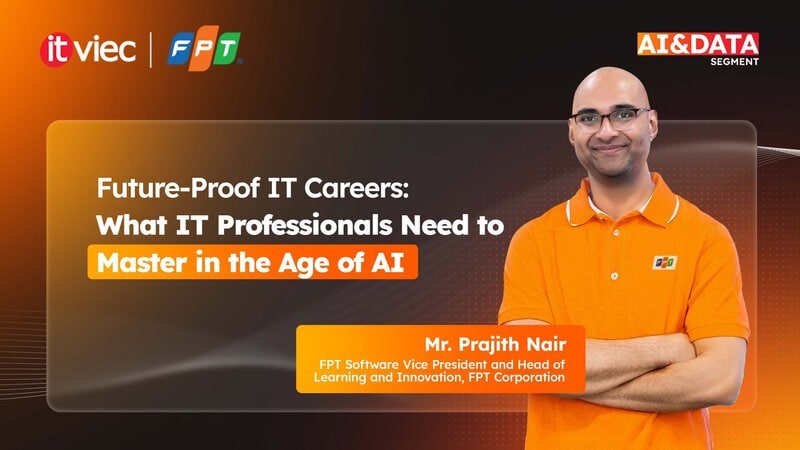
The era of defining an IT career by the number of lines coded or bugs fixed is coming to an end. As Artificial Intelligence permeates the software industry, it is not merely acting as a tool; it is establishing a completely new “production system”. According to Mr. Prajith Nair, FPT Software Vice President and Head of Learning and Innovation at FPT Corporation, the workforce is undergoing a fundamental shift from executing isolated manual tasks to orchestrating high-level business value.
Based on the insights from the interview with Mr. Prajith Nair – FPT Software Vice President and Head of Learning and Innovation, FPT Corporation, IT professionals who want to survive and succeed in this era depend on making a critical transition: moving from being a “task-doer” to an “outcome-driver”. Let’s dive in!
The Shift: From micro-tasks to value outcomes
In the traditional software model, engineers often functioned like assembly line workers. They focused on “micro-tasks”, writing a specific function, building a database table, or fixing a list of errors. Success was measured by volume: “I wrote 10 lines of code today” or “I fixed 15 bugs”.
In the AI era, this metric is obsolete. Because AI has access to the “collective intelligence” of the global code base, it can handle these repetitive lower-level tasks faster than any human. Consequently, the industry is outsourcing the “boring” labor to AI agents, pushing human professionals up the value chain.
The new measure of success is business outcome. Instead of reporting on effort, the AI-augmented engineer reports on impact:
- Old Metric: “I completed the coding requirements”.
- New Metric: “I enabled the application to run 15% faster” or “I helped the client acquire 20% more customers”.
This shifts the human role toward “full stack maturity,” where engineers must understand and deliver end-to-end business value. Instead of reporting on code volume, the new IT workforce evaluates success based on business outcomes, such as:
- Did the application run faster?
- Did it acquire more customers?
- Did it generate more revenue?
The new role: From creator to auditor
This shift changes the mechanics of daily work. Previously, a developer’s primary value was writing code from scratch. Today, the role is shifting from creator to reviewer.
As of now, IT professionals are being urged to stop viewing AI merely as a tool and instead view it as a new “production system”. Since AI can generate code instantly, the human engineer must become an intelligent auditor. They orchestrate the AI to do the heavy lifting, then use their judgment to verify, correct, and integrate that work into the specific business context. This requires new roles to emerge, such as AI Augmented Engineers. They are the people who use AI tools throughout the software delivery lifecycle, from requirement analysis to testing. This “AI Augmented” approach allows staff to deliver software faster, focusing their energy on the destination rather than the journey.
There is a specific urgency for non-technical roles that do not adapt. Mr. Prajith Nair stresses that roles which are “non-AI augmented”, such as traditional Business Analysts who only perform manual analysis, will likely see reduced demand because AI agents can handle these tasks efficiently. To remain relevant, these professionals must pivot to becoming AI Champions who are strategists and consultants who understand end-to-end AI workflows and help customers identify where AI can unlock business value.
How to transform yourself as a Developer?
If you are currently working in a task-based role, how do you bridge the gap to this new outcome-based reality? Here is the roadmap:
1. Develop “Full Stack Maturity”
You do not need to master every programming language, but you must master the end-to-end value chain. This concept, known as “full stack maturity”, means looking beyond technical requirements to understand the ultimate value being delivered to the customer.
In order to achieve this stage, the most critical step is to stop defining your work by the volume of labor you perform. You must stop viewing software development as a checklist and start viewing it as a production – similar to producing a movie with many moving parts, stakeholders, and layers of value (stakeholders, data, AI tools).
2. Build to learn, not just study
Theory is no longer enough. To survive this shift, you must adopt a “maker” mindset. Mr. Prajith Nair emphasizes that you cannot learn AI solely by reading about it; you must build with it.
His advice is that you can pick any AI stack (e.g., Azure, OpenAI) because the specific tool matters less than the habit. Learn it, build a solution, and release it to your community or colleagues.
This moves you from a passive learner to an active “maker,” helping you understand how to integrate AI into a complete product (“the outcome”) rather than just knowing how the technology works (“the task”)
3. The Captain mindset
To visualize this transformation, Mr. Prajith Nair offers a powerful analogy involving a ship’s captain. In the era of the Titanic, if a captain wanted speed, he issued a command that traveled down to the lower decks, where hundreds of workers manually shoveled coal into boilers. These workers were performing micro-tasks or task-based work – working hard without seeing the horizon.
Today, AI gives every developer the power of a modern captain. You now have a lever (AI) that can accelerate the ship instantly. You no longer need to be the one shoveling the coal. Instead, your value comes from standing on the bridge, understanding the destination, and knowing exactly when and how to pull the levers to get there.
Final thoughts
The future belongs to those who stop counting tasks and start delivering value. By treating AI as a production system and adopting the mindset of a captain, IT professionals can move away from repetitive labor and toward a career defined by intelligence, strategy, and impactful results.
| This insightful interview marks the collaboration between ITviec and FPT to bring forward authentic conversations with leading tech leaders in AI and Data. Together, we aim to help Vietnam’s IT professionals gain practical perspectives on AI, Data, real stories and challenges in emerging technologies — bridging the gap between industry vision and career growth. For more insight from other leaders and latest job opportunities in AI/Data field, visit ITviec’s AI/Data Segment now! |
